
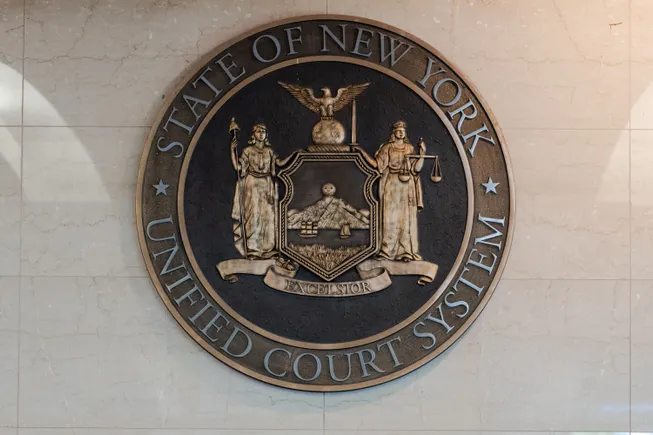
Plaintiffs alleging religious discrimination under Title VII of the 1964 Civil Rights Act must show that an employer’s adverse action was motivated by a desire to avoid granting an accommodation rather than mere knowledge of the plaintiff’s need for an accommodation, the 2nd U.S. Circuit Court of Appeals held Sept. 15.
The decision in Bergin v. New York State Unified Court System concerned a former court officer’s exemption request from a COVID-19 vaccination mandate. The plaintiff informed the New York State Unified Court System, or UCS, that the mandate conflicted with her religious beliefs.
UCS followed up to ask the plaintiff to fill out a questionnaire with more details, which the plaintiff failed to timely submit. She was later discharged after failing to comply with the mandate and sued for failure-to-accommodate under Title VII.
A district court granted partial summary judgment to the plaintiff. It applied the existing precedent of the 2nd Circuit, which asked plaintiffs to show only that an employer knew an employee’s religious belief conflicted with an employment requirement in order to make a prima facie case of discrimination.
On appeal, UCS argued that the district court failed to apply an updated Title VII analysis articulated by the U.S. Supreme Court in 2015’s EEOC v. Abercrombie & Fitch. There, the high court held that an employee must actually require an accommodation of their religious practice and must show that their employer’s desire to avoid granting the accommodation motivated an adverse decision.
The 2nd Circuit agreed that Abercrombie had overturned circuit precedent and vacated the grant of summary judgement to the plaintiff in Bergin. It further directed the district court to apply the Abercrombie standard. Notably, it also disagreed with the court’s holding that UCS had made a judicial admission that the plaintiff adequately communicated a conflicting religious belief.
The court clarified in a footnote that it did not mean to suggest that plaintiffs have to meet a “new, heightened discriminatory motive requirement” in showing failure to accommodate. Plaintiffs must only show that denial of an accommodation was due to the employee’s religion rather than some other reason, it said, such as the employee’s failure to timely provide certain information.
The Bergin decision “reinforces the importance of a thoughtful, consistent, and well-documented approach to spotting, assessing, and responding to potential religious accommodation issues,” according to an analysis written by Emily Tortora and Hayley Klein, attorneys at Venable LLP.
COVID-19 vaccination policies have become a frequent subject of religious discrimination litigation in recent months. This is especially so in the 9th Circuit, which has issued several notable decisions in cases involving plaintiffs who requested accommodation from such mandates.
In one example, the 9th Circuit held in favor of a former consultant, a Christian Jew, who cited Bible passages in her initial request for a vaccination mandate exemption. Her employer requested that the plaintiff submit further information, which the plaintiff only partly provided. The employer then placed the plaintiff on unpaid leave before firing her. The 9th Circuit ultimately held that the plaintiff provided sufficient notice of her beliefs, in part because the employer initially approved her request before later revoking it.