
The U.S. Equal Employment Opportunity Commission has not shied away from aligning itself with President Donald Trump’s agenda since he took office in January 2025, with alleged majority-group discrimination based on diversity, equity and inclusion programs and national origin bias against Americans rising to the top of the agency’s priority list.
With a few recent charges it has pursued, EEOC has also signaled a drastic departure from — and in some ways, a 180-degree turn from — how the Biden-era version of the agency interpreted certain rights in the workplace.
Back in April 2024, the agency finalized enforcement guidance on harassment in the workplace, updating guidelines to incorporate gender identity following the U.S. Supreme Court’s landmark Bostock v. Clayton County, Ga. decision, as well as more recently relevant cultural changes, like more remote work and more widespread genetic information.
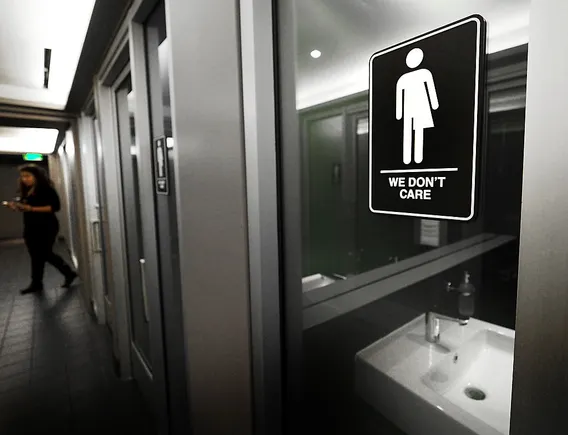
Per that document, harassment based on gender identity could include misgendering, pestering related to a gender-nonconforming appearance and denial of access to a bathroom or other sex-segregated facility that aligns with an individual’s gender identity.
EEOC dispensed with the guidance in January — an unsurprising move, as Chair Andrea Lucas had expressed her opposition to the guidance since the beginning of the second Trump administration, shortly after she was named acting chair.
EEOC’s hard pivot
In two recent litigation actions, EEOC once again flipped the script. Actions that the Biden-era commission had identified as potential gender-identity harassment were instead named as potential accommodations for, or harassing actions toward, other employees.
EEOC announced an agreement with generator manufacturer Generac Power Systems on Wednesday, alleging the company violated Title VII of the Civil Rights Act of 1964 after it didn’t consider a reasonable accommodation when an employee requested to use “biological pronouns” for a transgender employee.
“Consistent with Executive Order 14168, the EEOC will continue to prioritize for enforcement charges that involve protecting religious beliefs where an employee seeks to express the biological reality of sex in the workplace,” Lucas said of the agreement.
In a different case the agency announced on Tuesday, O’Fallon, Illinois — a city of nearly 35,000 residents just outside of St. Louis — agreed to resolve a claim of sex discrimination and retaliation after an EEOC investigation found “the city subjected an employee to harassment when it failed to provide a sex-designated locker room for use only by women, and then disciplined her in December 2025 because of her sex and her protected activity of asking for the designation.”
Neither investigation resulted in a lawsuit, making the specific details of the cases unavailable. However, in the first case, the employer agreed to a monetary payment as well as updating its policies and training on the “effective handling” of religious accommodation requests. The latter case concluded with a five-year agreement and “nonmonetary relief,” including designating locker rooms and shower facilities by “Men” and “Women.”
The move shows that the tension between religious rights under Title VII and sex-based rights under Bostock has come to a head at the government’s equal employment watchdog.
Employers contend with risk
But EEOC is not the only enforcement arm with a say in the matter, Sam Schwartz-Fenwick, partner at Seyfarth Shaw, told HR Dive. In more than 20 states, employers are subject to laws that protect against gender identity discrimination. Additionally, a number of jurisdictions — “including in deep-red states,” he noted — have similar policies in place.
To date, no court has sided with EEOC on the issue, because it has yet to be litigated, Schwartz-Fenwick said. But as the issue inevitably lands in the federal courts, judges will have to contend with federalism questions regarding the scope of Title VII, he said. Namely, is it a ceiling or a floor? Can states offer broader protection?
The issue is likely to hit the appeals courts, Schwartz-Fenwick said, and it could eventually land in the U.S. Supreme Court. While SCOTUS has reaffirmed in U.S. v. Skrmetti that Bostock remains “good law,” some have interpreted the decision as “potentially narrowing” Bostock, he noted. If the Title VII conflict does hit SCOTUS, “I’m not sure anyone could predict what that ruling would be,” Schwartz-Fenwick said.
How to proceed
For employers attempting to navigate pronoun or bathroom situations amid a diverse workforce, Schwartz-Fenwick noted that when someone raises an objection, employers have a duty to try to accommodate — and that can involve thinking outside the box.
Regarding the pronoun request, for example, an employer could ask about moving the objecting employee to another shift, a different team or an office further from the other worker to limit contact. Notably, EEOC found fault because the employer “did not fully engage in the reasonable accommodation interactive process” before denying the request to use “biological sex-based pronouns,” not because it denied that specific request.
“I don’t see anything in this conciliation that’s saying it’s reasonable to allow someone’s religious objection to entitle them to call a colleague by the wrong name or pronoun,” Schwartz-Fenwick said.
When it comes to bathrooms or changing rooms, having a gender-neutral, single-occupancy bathroom or other space can mitigate risk, he said. But it doesn’t remove it entirely.
“You’re still dealing with, if someone raises an objection, who is then asked to use that single occupancy restroom,” Schwartz-Fenwick said. In other words, are single-gender bathrooms the norm, with a person with religious or other objections asked to use the single bathroom? Or are single-sex bathrooms the norm, with a transgender person asked to use the single bathroom?
Here, EEOC did make a definitive interpretation: “Failing to provide women with sex-designated facilities can constitute unlawful sex discrimination and expose employees to harassment,” Lucas said in a release.
“The view of the EOC has shifted, and no court has agreed with it yet,” Schwartz-Fenwick said. “Which doesn’t mean they won’t. It just hasn’t happened yet.”
In the meantime, he recommended employers have their lawyers “on speed dial” to talk through every thorny situation that emerges involving a tangling of employees’ religious and identity rights. But even they can only provide the best knowledge of current risk.
“There’s not a risk-free choice in this space,” he said. “It’s a balancing of risks until the law gets settled, and we’re just not going to be in a place where the law is settled here for at least a few years, if not longer.”