
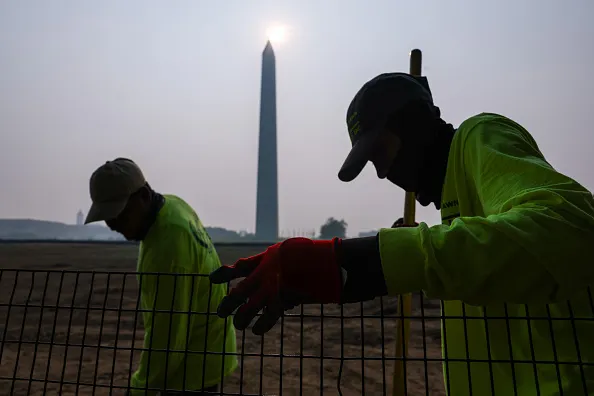
In mid-July 2026, a wave of poor air quality struck the midwest and eastern U.S., prompting air quality alerts by public health authorities. The widespread haze — generated by wildfires in the U.S and Canada — represented the kind of extreme weather events made worse by climate change, experts told CBS News.
The event had a direct effect on workplaces. In one example, a Ford Motor Co. assembly plant in Michigan saw workers hospitalized due to the combination of heat and smoke, the Detroit Free Press reported. In Albany, New York, outdoor workers took precautions such as setting up water stations and large cooling fans.
When weather events put employee health at risk, they may trigger employer obligations under the Family and Medical Leave Act and similar state or local laws, said Ellen Donovan McCann, of counsel at Littler Mendelson.
She added that while there hasn’t been a discernible upward trend in leave associated with climate extremes at present, a growing amount of attention is being placed on the topic. This is especially the case with respect to chronic health conditions, like cardiovascular disease or asthma, which can be triggered in moments of extreme heat, air pollution or a similar phenomenon.
“We certainly have talked about the potential impact,” McCann said.
Employers should be mindful that climate change is expected to lead to an increase in chronic health conditions, said Pierce Blue, of counsel at Morgan Lewis.
Outdoor workers are particularly affected by climate-related hazards, according to a 2023 study published by the Journal of Occupational and Environmental Hygiene. The study’s authors noted that while more research is needed, evidence suggests that workers are experiencing increased morbidity and mortality related to climate change.
“It would make perfect sense if that were to lead to an increase in claims or time off,” Blue said. “Any increase would be concerning on [the employer’s] part.”
But employers also could see the effects of climate change in the FMLA context more indirectly, McCann noted, such as when an employee asked to take leave to care of a family member affected by severe weather. It’s important to be vigilant as it can already be difficult at times for employers to identify FMLA-qualifying events involving family members, she said.
She gave the example of an employee who asks for time away from work to move an elderly parent to a new long-term care facility. The FMLA’s eligibility criteria capture a broad range of conditions or circumstances and could include care of this sort. By extension, if an employee is taking care of a family member with a health condition who is at risk due to flooding, air pollution or another form of weather emergency, that also may qualify, McCann said.
“Employers might not be making the right connections or at least asking the right questions to know whether it’s FMLA,” McCann added.
Similarly, there could be a mental health component to climate-related FMLA claims, said Matt Brown, partner at Thompson Coburn. Should an employee report anxiety caused by extreme weather, for instance, this also may be a qualifying reason to take FMLA leave.
How to adjust compliance and policies for climate change
Awareness is key, McCann said. Employers will need to monitor weather reports and local public safety alerts to know when poor air quality, extreme heat or similar conditions are anticipated. Additional FMLA or alternative leave claims should be expected on such days, and employers must train staff to listen to the entirety of a given employee’s situation to determine what next steps are appropriate.
“Any time an employee needs to be absent from work, make sure you have enough facts to know if there is an obligation that’s been required,” McCann said. “Employees don’t need to use magic words — they don’t have to say, ‘I need FMLA.’”
Where possible, employers might want to consider remote or hybrid work for employees who may be affected. “That helps staffing plans because a lot of time these things come out of the blue,” Brown said, adding that certain weather events can lead to the shutdown of local transit networks or commuter pathways that workers use.
Employers should have medical certifications on file for employees with relevant health conditions, Blue said, to ensure smoother recordkeeping on the employer’s end. But training managers to recognize FMLA scenarios may be the most important task because failure to do so constitutes the biggest risk for violations, he noted.
“I don’t think the training needs to be super intense or that managers need to have a clinical knowledge of the FMLA,” Blue said. “It’s more important that, if somebody says they need time off for a medical reason or to care for their children […] know that that could be FMLA and that you should be looping in HR or legal.”
States, localities provide guidelines
Employers have a general duty under the Occupational Safety and Health Act to protect employees from recognized hazards, but there are no particular OSHA standards specific to climate extremes or similar weather events, Blue said. Still, that doesn’t mean they are flying blind.
State and local authorities are likely to have a variety of resources, or even legal standards, to guide employers in their response. For example, at least seven states have occupational heat safety standards, according to the Natural Resources Defense Council. And in New York City, Mayor Zohran Mamdani signed an executive order in June requiring local agencies to develop heat safety plans for city employees and contractors.
Even when such regulations are not intended to cover private businesses, employers can look at those policies to formulate best practices, Brown said.
Moving forward, employers also might want to consider tracking leave trends either on their own or in conjunction with third-party leave administrators, he added. This data could be compared against historical extreme weather events or alerts to determine any correlation and adjust protocols accordingly.