
Dive Brief:
- Peak office utilization has risen above pre-pandemic averages as workplace managers enforce attendance policies and prioritize desk sharing, rotating schedules and flexible arrangements, according to a CBRE report released Thursday. Peak use globally averages 80%, compared to 65-75% pre-pandemic, the report says.
- There was also a surge in average office use in 2025, the report says. Global average office use rose to 53%, compared to 38% in 2024, marking the largest annual gain since 2021, the report states. The share of organizations enforcing in-office policies doubled to 37% in 2025, while the share of workplaces measuring policy compliance rose to 69%, from 45% in 2024.
- The acceleration has been driven both by more enforcement of attendance policies and workplaces winning over employees “with the promise of connection,” CBRE says.
Dive Insight:
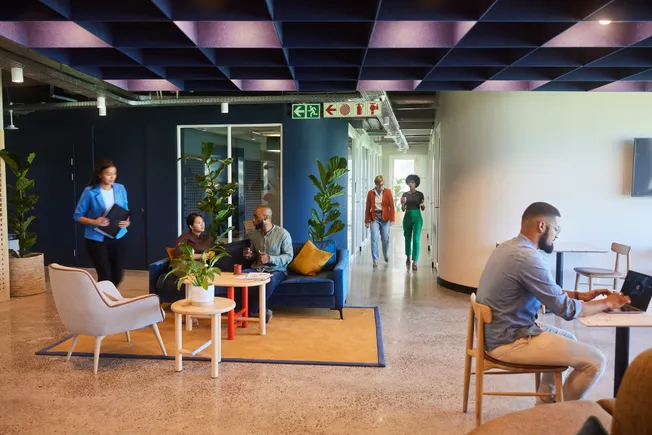
The private and public sector’s push to bring employees back to the office coincides with a shifting view of what a productive office environment looks like, research shows. The emerging office is organized around the team and relationships rather than the traditional focus on the individual and the task, CBRE says.
In the Americas, the number of shared support spaces — like meeting rooms, project rooms and informal gathering areas — increased by 35% from 2021 to 2025, compared to an equal drop in individual spaces designed for heads-down, task-focused work, according to the report.
Amenity spaces designed for social connection, shared experience and informal interaction were the fastest-growing category, up by 120% since 2021.
“This growth reflects organizations’ rising conviction that culture is cultivated, not assumed,” CBRE said in its report. “If utilization data indicates that people are returning to the office, then space allocation data indicates what they expect when they get there.”
The report also found that global occupancy rates are now 111%, meaning more people are sharing space. The 1:1 employee-to-desk ratio, once universal, is now the exception, with most organizations moving toward ratios between 1.01 and 1.49 employees per seat, CBRE says.
While a third of organizations are pushing beyond 1.5 employees per seat, an overwhelming majority, or 83%, are factoring in job function when determining sharing ratios. Over three-quarters are calibrating these ratios using space utilization data, the report says.
Looking ahead, the firm expects utilization to continue to rise through 2027. The growth will be driven by a combination of policy enforcement, stronger cultural alignment and a growing recognition that in-person connection is a strategic advantage.
“Organizations that have already invested in collaborative and social spaces will be better positioned to realize the full value of this trend,” CBRE says. “Employees will vote with their feet for environments that make the trip worth it, while leaders will need the office to deliver on its promise of culture and performance.”