
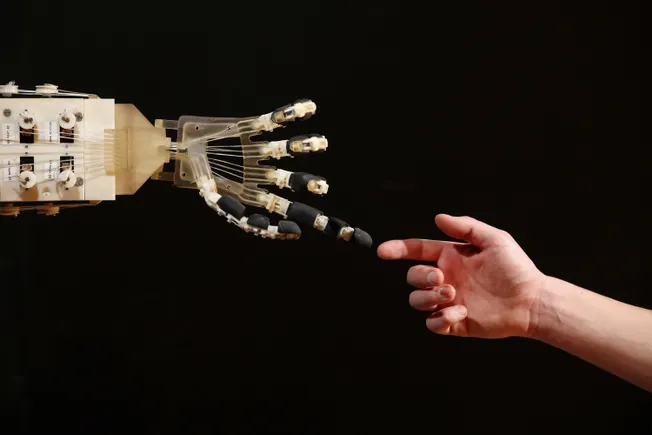
In 2012, a West Virginia coal miner’s religious objection to his employer’s use of a biometric hand scanner led to his firing and, after a lengthy legal dispute, an award of more than half a million dollars in damages. Legal experts believe a similar controversy may befall unsuspecting employers that have deployed artificial intelligence in the workplace.
Religious discrimination claims have exploded in frequency within the past few years, said James Paul, shareholder at Ogletree Deakins. Paul, who said he’s been advising companies on employment law for about two decades, noted that he rarely fielded clients’ questions about religious objections or inquiries for the majority of his career.
Then the COVID-19 pandemic hit, and with it, a slew of requests from employees challenging employers’ policies on vaccination, masking, testing and similar issues. This spurred a “rapidly increasing trend,” according to Paul. In earlier times, “maybe I would get one objection a month or one inquiry a month, sometimes once every two months,” he said. “Currently, not a day goes by where I don’t get two or three.”
In 2026, another trend is consuming HR and employers writ large: AI. The technology has become a disruptive force, with 91% of CHROs in a March poll by CHRO Association and the University of South Carolina’s Darla Moore School of Business stating that AI was their most immediate area of concern.
The two trends have now begun to meet, Paul and others told HR Dive, and without much case law to guide compliance, employers may find themselves preparing for novel questions as they navigate that collision.
“If you’re encountering this, there’s a good chance you might be the test case,” said Evan Peña, partner at Quarles & Brady. “No employer wants to be in that position.”
A fingerprint scanner at the Minneapolis-St. Paul International Airport on July 7, 2004, in Fort Snelling, Minn. A mid-2010s lawsuit involving a coal miner’s religious objection to the use of a biometric hand scanner may provide some insight to employers about religious accommodation requests involving AI tools, attorneys said.
Eric Miller via Getty Images
The complex nature of religious objections to AI
Resistance to AI is not exclusive to those with religious or spiritual beliefs. Many organizations have reported instances in which employees are hesitant to adopt the tech or are outright hostile toward using AI.
But when a religious objection to AI is raised, according to Paul, it tends to deal with one of two categories: AI’s environmental impact and the infrastructure and energy required to power it or the loss of autonomy in human decision-making that may be accompanied by AI — especially in the case of “agentic” AI. Either may cut against an employee’s personal convictions.
Others may be concerned that using AI is unethical because it can displace human workers or because it could be, and by some accounts has been, used to conduct illegal acts, especially in the context of AI warfare, said Nancy Delogu, shareholder at Littler Mendelson.
Sources who spoke to HR Dive could not cite any specific mainstream religious texts or organizations that prohibit AI use altogether. Paul noted that some large religious groups have issued ethical guidelines regarding AI, though such documents tend to speak about use of AI in an ethical manner rather than directing adherents to avoid all such use.
However, an employee’s sincerely held religious belief or practice does not have to be approved, directed or communicated on by any kind of organized religion, Paul said. Even where an organized religion has taken a moral stance on a particular issue, that statement may leave room for individual adherents to formulate their own convictions, he added.
For example, the plaintiff in the aforementioned West Virginia miner case, EEOC v. Consol Energy, Inc., feared damnation as a result of using a hand scanner, a technology he believed would be used by the Christian Antichrist to identify followers with the mark of the beast.
“That was an example of a unique and unusual belief or objection that wasn’t really backed up by organized religion or actual doctrine, and yet it was successful under the law because the individual demonstrated to the jury that it was a sincerely held belief,” Paul said.
Federal courts have been hesitant to question sincerely held beliefs, according to Peña. He pointed to the U.S. Supreme Court’s 2022 Kennedy v. Bremerton School District decision, in which the court avoided a discussion about the sincerity of a high school football coach’s belief that he had to offer a prayer at midfield after games. Such deference means it could be difficult for employers to challenge sincerity, even if the belief or practice appears unusual, he said.
Regulators, including the U.S. Equal Employment Opportunity Commission, are similarly reluctant to call a sincerely held belief into question. For that reason employers should be “very cautious” before attempting to challenge an employee’s religious belief on its own, said Nathaniel Glasser, member of the firm at Epstein Becker Green.
“To the extent that they have objective information that an employee does not have a sincere belief or that the belief is not religious in some way or another, that may be possible,” he said. “But that’s a potentially risky endeavor.”

A man prays in a church in Birmingham, England, on Dec. 24, 2018. Employers should ensure they have an understanding of an employee’s specific religious objection to AI when processing requests, sources told HR Dive.
Christopher Furlong via Getty Images
For starters, focus on necessity
Employers can’t reasonably grant all accommodation requests they receive, and when it comes to AI, it could be difficult for employers to determine whether an employer’s objection is truly religious or is more akin to discomfort. But federal laws are clear that if an employer is faced with a religious accommodation request, the analysis is the same, said Delogu.
“The employer has to take a look and try to understand what the objection is and whether that can be accommodated,” she added.
Delogu gave the example of one request fielded by a client from an employee whose work involved the creation of digital films and videos. The employee claimed that it was against his religious beliefs to work on projects that incorporated AI-generated imagery. Delogu said the client in question was still in the process of gathering information to address the request, but that such scenarios demonstrate the multitude of questions involved.
For instance, an open question existed as to whether AI categorically includes digital tools that automatically enhance an image and whether the employee had already used such tools in the past. The client also needed to drill down into whether the objection extended to the act of uploading the employee’s work to an AI platform or whether the employer would even be capable of preventing such an upload from occurring in the first place.
“That’s as close as I’ve seen to the technology itself being an issue,” Delogu said.
A baseline consideration is whether an employee who has a religious objection to AI really needs the tech to perform their essential job functions. If not, a simple accommodation may be to exempt them from organizational AI use requirements, Paul said.
In Consol Energy, the plaintiff could have been accommodated via an alternative method to clock in or record his work hours. If the same logic were extended to an employee requesting exemption from using an AI-powered search engine, for example, Paul said an employer could instead permit the employee to use non-AI tech or even a physical reference book.
HR teams also might consider past decisions the organization has made with respect to employees who refuse to use AI for nonreligious reasons, Peña said. If those employees are able to perform their work without issue, that could be damaging to any refusal to accommodate on the employer’s part. Employers aren’t wedded to past precedent, Peña said, “but it is relevant, and a jury’s going to look at that.”
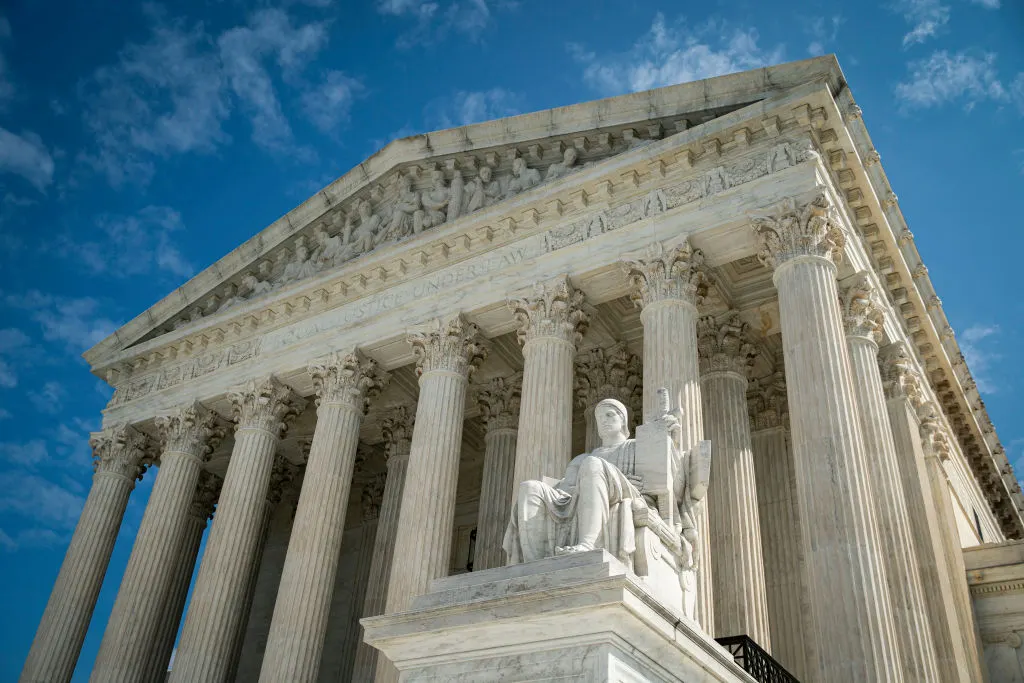
The U.S. Supreme Court building on Sept. 28, 2020, in Washington, D.C. A 2023 decision of the court heightened the standard under which employers must show that a religious accommodation request poses undue hardship.
Al Drago via Getty Images
Showing undue hardship could prove tricky
Employers face a higher burden to show that a proposed religious accommodation poses an undue hardship under Title VII of the 1964 Civil Rights Act following the Supreme Court’s 2023 Groff v. DeJoy decision. There, the court held that the burden posed by an accommodation must be “substantial in the overall context of the employer’s business.”
The court’s bar can be a difficult one for employers to meet, said Peña, particularly for larger employers. For that reason, accommodation decisions are more often a function of the specific job the employee holds and whether the business can provide an effective accommodation, he added.
But an interesting wrinkle concerns AI’s efficiency and whether the tech could advance to the point where employees who use it far outperform those who don’t.
Peña offered a hypothetical of two customer service employees, one who uses AI and one with a religious exemption who does not. If the former is completing 40 customer tickets per day while the latter completes only three per day, Peña said that could raise the question of whether the employee with substantially low productivity is really completing their job’s essential functions.
EEOC’s post-Groff guidance notes that employers may take into account factors such as increased operating costs, infringement on the rights of other employees and decreased efficiency when analyzing potential undue hardship. This analysis will be a fact-based, individualized determination, Glasser said, and the more objective factors an employer can point to, the better their chances of showing that opting out of AI use would pose undue hardship.
“Employers should be thinking now about the types of AI tools being offered to their employees and what those tools are intended to do with respect to each individual that’s going to be using them,” he added.
Another factor to consider is whether AI is so ubiquitous in a given work process or job that opting out would be unfeasible. Glasser illustrated this using a hypothetical manufacturing assembly line. The line incorporates AI such that even workers who perform only manual tasks are interacting with goods whose production is at least partly AI-assisted.
If a manual worker in this example asks for a religious accommodation permitting her to avoid interacting with products made by AI, that may be a very difficult ask for an employer, Glasser said. Evaluating the request could involve parsing just how distant a given job’s relationship is to AI.
“Employers will likely have to be prepared to engage in those discussions and get a better understanding of the underlying [religious] belief and what the employee believes they can and cannot do vis a vis AI,” Glasser said.
Fall back on process
Regardless of an employer’s ultimate determination, it should treat religious accommodation requests consistently, said Tracey Diamond, partner at Troutman Pepper Locke. It’s a best practice, she added, for the employer to designate an internal point-of-contact who can receive such requests, consider them and process them fairly and consistently.
AI may present novel challenges, but much of the standard for evaluating accommodation requests remains the same, according to Paul. That includes documenting all aspects of the evaluation, from the specifics of the request itself to any operational burdens, anticipated costs, impracticalities and other issues that may show undue hardship.
“It bears repeating that there may be some requests from people who share those beliefs out of left field, and we’ve got to treat those seriously.”

Nancy Delogu
Shareholder, Littler Mendelson
A common problem is that employers often don’t have the same robust processes for dealing with religious accommodation requests as they do for similar requests, such as those for disability-related accommodations, Paul said. He advised HR teams to audit their policies and procedures, down to the forms they use to process requests, to ensure they have an effective framework.
Employers also must not begin the process on the wrong foot, namely by doubting the sincerity of a particular religious belief, Delogu said. Similarly, HR can’t outright reject requests that would be difficult to accommodate. Those evaluating accommodation requests must take time to understand what the employee is asking for and speak with the employee about potential alternatives.
“It bears repeating that there may be some requests from people who share those beliefs out of left field, and we’ve got to treat those seriously,” Delogu said.