
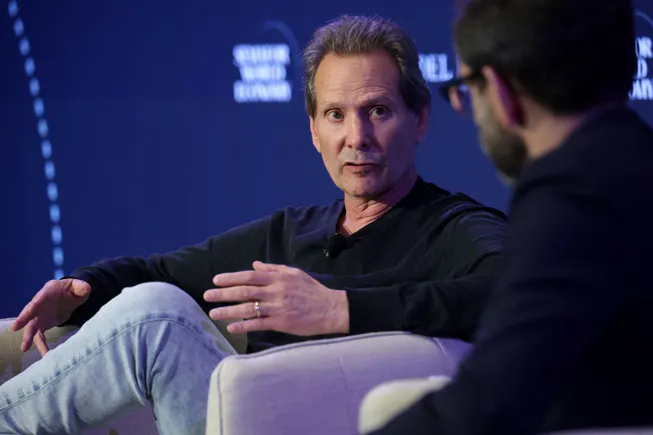
Artificial intelligence will replace “a large percentage” of Verizon customer service, CEO Dan Schulman said at Bloomberg Tech conference in San Francisco Thursday.
“For sure, you’re going to see disruption with AI in certain job functions,” Schulman said. “I don’t see how that isn’t possible.”
Since taking the helm of Verizon in October, Schulman has focused on improving the customer experience of the wireless carrier as the company works to take back market share and “win.”
To take back market share, Verizon needs to differentiate.
“When you come into our stores how quickly can we help you?” Schulman said. “When you call into customer service, do you get someone who is empathetic? Do what they see match what you heard in the store and on your bill?”
“That’s really really difficult, that’s the end-to-end customer experience, and that’s hundreds if not thousands of things you need to do better, and we are focused on every single one of those incrementally getting better,” Schulman said. “Because I feel if we can have the best end-to-end customer experience, that’s real differentiation because it’s really hard to imitate and it’s extremely hard to do but extremely appreciated by customers.”
Customers will feel those changes incrementally, and Schulman says the wireless carrier plans to improve the value proposition month after month. Because AI can ingest all this data around a customer, Verizon’s value proposition “should be tailored to the 300-plus different ways we can look at you.”
How AI will change customer service work
Leaders have a responsibility to talk about what could happen as a result of AI, according to Shulman. Among those impacts: many aspects of customer support will be automated, he said.
“What we’re seeing in our customer service is that the rote stuff can be done by agents, more complex stuff is a combination of an agent and a human working hand in hand to satisfy an agent much better than either can do alone,” Schulman said.
AI “will dramatically improve our ability to satisfy customers,” Schulman said. “In the last three months, we have been experimenting with agents that are replacing some of our customer service reps. And those agents, their customer service satisfaction rate is 1,280 basis points better than what we had before.”
Schulman isn’t the only one forecasting AI taking over customer service jobs. Last week, Forrester predicted that AI will slash the number of customer service jobs in half by 2030, and the number of customer service jobs handling easy questions is only going to decline.
“Over time the automation is going to get more and more sophisticated, so the number of agents, human agents working with customers, is going to go down more over time,” Max Ball, at Forrester, told CX Dive.
Of the remaining customer-facing roles, many “will be brutally hard,” as representatives take on only complex and sensitive matters, according to Ball.
But there are also going to be AI specialist roles.
“We’re going to start shifting from people talking to customers and looking up simple things to people teaching AI how it can look up these simple things and making sure that the data is clean and correct and writing procedures for the AI to follow, etc.,” Ball said.