
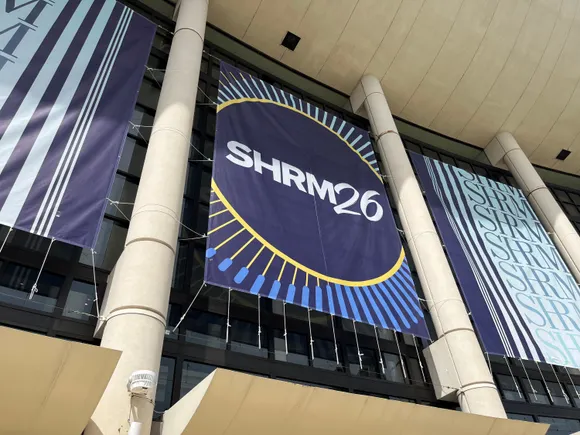
ORLANDO, Fla. — HR professionals can’t escape talk of artificial intelligence in 2026, so it may seem fitting that SHRM26 attendees could scarcely listen to a single session at the conference without hearing AI discussed.
Speakers offered varied perspectives on the latest technological trend, ranging from the philosophical to the practical. Here, HR Dive recaps some of the insights provided by executives, stakeholders and thought leaders.
1. Simon Sinek: If you forget about people, you’re doing AI adoption wrong
The Wednesday crowd at the Orange County Convention Center frequently applauded points made by author Simon Sinek. Sitting down for a 1-on-1 with BambooHR CEO Brad Rencher, Sinek had a pointed message for HR professionals struggling to balance the hype and promise of AI with the anxiety it has caused.
“These are emotions,” Sinek said. “These are all human things.”
Employers are already struggling to keep up with technological change, but this is only further amplified if they fail to effectively talk through employees’ anxieties with them, he continued. Sinek called on employers to invest in teaching human skills that, in turn, build a community-focused culture, allowing employees to grow together through change.
At the same time, Sinek cautioned against “toxic positivity,” in which employers overly reassure workers that “everything is fine, we got this.” Employees seek confidence and the knowledge that the employer has their back, he added. To that end, employers should instead frame their communications around AI strategy on how AI will affect employees personally and how the organization will work together to ensure every decision made is good for its people.
“We are human beings who work with human beings who sell to human beings, and if you don’t understand human beings, you don’t belong in business,” Sinek said.
2. Kathleen Pearson: Start with small problems first
Faced with a sweeping new technology, HR may be confused about how to best move implementation forward.
If that’s the case, departments might consider starting with a “micro pain point,” or a singular time-intensive task that could be freed up via AI or automation, providing an immediate use case to demonstrate to leadership, said Kathleen Pearson, CHRO at Opensity Solutions, a managed services organization.
Pearson said her team had been in the process of integrating three separate company handbooks as part of a merger between three organizations. Working with Anthropic’s Claude, Pearson’s team ran cross checks to track any conflicting policies between the different handbooks as well as a legal review.
In the end, Pearson said this process gave her 65 separate places to surface with her general counsel during forthcoming discussions about the handbook — a process, she noted, that would have taken her and her team several weeks to accomplish manually. With AI, they did it in three hours.
“Once you do that once […] it’s repeatable, and it spreads throughout without having to do a very top-down approach,” Pearson said, adding that these smaller AI use cases can be a pathway to adoption that is not too budget-intensive.
3. Johnny Taylor: Use AI’s time savings on meaningful work
For SHRM President and CEO Johnny Taylor, AI helps cut down on repetitive day-to-day work. During an exclusive interview with HR Dive, Taylor said he’s especially noticed this effect with respect to his email inbox.
Taylor told HR Dive that he responds to every email he receives from SHRM members. AI helps facilitate that goal by providing a first draft of each response that he later checks and personalizes before sending. In all, the process helped him reclaim about one hour per day, and he said he now has significantly more time to walk the halls of SHRM’s headquarters and interact with employees.
“HR people should not use this time to free themselves up and go on vacation, but [should instead] return to human work,” Taylor said.
4. Kate Noel: Be the case study
If HR wants the rest of the organization to embrace a new tool, practitioners might need to lead the way, said Kate Noel, senior VP and head of people operations at Morning Brew, a business media company.
Noel talked about how the company has developed an AI integration within Slack, Brew Bot, that serves as a central place for employees to ask various service- and business-related questions and receive prompt answers. Meanwhile, she said the organization’s HR team can use the data gathered on the back end to better identify where to spend education and training resources.
Noel said the initiative is one of several that she and other members of Morning Brew’s HR staff have undertaken to demonstrate good AI use for the rest of the organization. She also highlighted an internal AI committee in which participants spend time determining future use cases, noting that exact use cases for AI may differ from job to job.
“It’s a great signal because if I’m doing that as the head of HR for my team, I’m hoping that it makes the people on my team also feel psychologically safe to do it as well,” Noel said. “I like to think of HR as one of the spaces where, if we do something, it impacts everything.”
5. Alex Alonso: Cultivate a comprehensive approach to AI use
HR departments must help build a “playbook” for AI adoption in the long term, Alex Alonso, chief data and analytics officer at SHRM, said in an interview with HR Dive. While that process is multi-faceted, Alonso said a large component is instilling within employees a comprehensive mindset with respect to using the tech.
In practice, that means not only ensuring that employees are open to using AI for various problems — or, in some cases, identifying when AI should not be used — but also that they are able to use AI in a nuanced manner.
For instance, HR professionals should caution employees against accepting the first response that they receive from chatbot like Claude or ChatGPT, Alonso said, and instead further refine prompts to receive more accurate and sophisticated outputs. HR also can instill the importance of using more than one form of generative AI model for a given task, he added.