
Dive Brief:
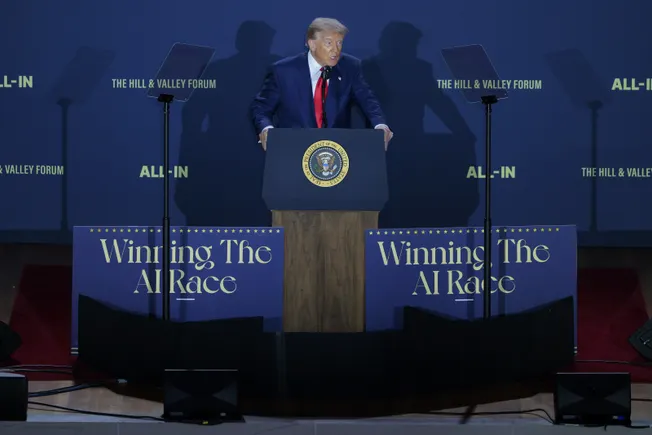
- The White House on Friday proposed a national framework for regulating artificial intelligence, calling on Congress to preempt conflicting state laws that “impose undue burdens” on companies.
- The plan focuses on priorities such as streamlining federal permitting for AI data centers, addressing intellectual property concerns related to the training of AI models, and ensuring an AI-ready workforce through skills development programs. The administration signaled that it favors a light-touch regulatory approach, urging Congress to avoid the creation of new federal rulemaking bodies for AI and instead support development and deployment of the technology through existing agencies and industry-led standards.
- “Importantly, this framework can succeed only if it is applied uniformly across the United States,” the White House said in a statement. “A patchwork of conflicting state laws would undermine American innovation and our ability to lead in the global AI race.”
Dive Insight:
The legislative plan comes just over three months after Trump signed an executive order aimed at blocking “onerous” AI laws at the state level and promoting a national policy framework for the technology. The order called for the administration to work with federal lawmakers “to ensure that there is a minimally burdensome national standard — not 50 discordant State ones.”
The administration’s latest announcement comes amid rising concerns over AI and its potential harms — from deepfake scams to displacement of workers.
“The framework is light on substance and holds little surprises, but the throughline remains — this protects Big Tech’s bottom lines over everyday people,” Ben Winters, director of AI and privacy at the Consumer Federation of America, a Washington-based consumer advocacy group, said in an email.
Earlier in the week, Sen. Marsha Blackburn, R‑Tenn., unveiled a sweeping draft AI measure that would require U.S. public companies and other entities to disclose workforce effects of AI on a quarterly basis, among other provisions.
“Today, the Trump administration gave us a roadmap for AI, and I look forward to working with my colleagues to codify the president’s agenda, protect Americans, and unleash AI innovation,” Blackburn said in a statement.
The White House plan calls on Congress to “use non-regulatory methods to ensure that existing education programs and workforce training and support programs, including apprenticeships, affirmatively incorporate AI training.” The proposal would also expand federal efforts to study trends in “task-level workforce realignment driven by AI in order to inform policies supporting the American workforce.”
The administration also urged Congress to:
- provide AI resources to small businesses — such as grants, tax incentives, and technical assistance programs — to support wider deployment of AI;
- consider enabling copyrights holders to collectively negotiate compensation from AI providers, without incurring antitrust liability;
- augment existing law enforcement efforts to combat AI-enabled impersonation scams and fraud; and
- consider establishing a federal framework protecting individuals from the unauthorized distribution or commercial use of AI-generated “digital replicas of their voice, likeness, or other identifiable attributes, while providing clear exceptions for parody, satire, news reporting, and other expressive works protected by the First Amendment.”
The administration said Congress should preempt state AI laws that “impose undue burdens to ensure a minimally burdensome national standard,” while respecting “key principles of federalism.” Federal law should particularly govern in areas such as the setting of standards for AI development and testing, as well as requirements that would otherwise impose extra-territorial obligations on companies operating across state lines, according to the plan.
“The administration recommends that Congress explicitly preempt state laws that conflict with these federal standards while allowing states to enforce laws in limited areas such as child safety, certain local permitting, and zoning,” the document states.
The White House effort underscores the urgency of advancing U.S. leadership in AI, according to Matt Schruers, CEO of the Computer and Communications Industry Association, a trade group that lobbies for major tech companies including Amazon, Apple, Meta and Google.
“An overly restrictive approach not calibrated for risk may invite legal challenge, and will forfeit the opportunity to advance American competitiveness,” Schruers said in an emailed statement.
Winters said some of the administration’s stated goals, such as protecting people from AI-generated scams and curbing data abuse of minors, have been outweighed by the framework’s “pro-AI” stance on preemption and enforcement.
“We need to see money where their mouth is on the protections — more money for consumer protection agencies at both the federal and state levels,” he said. “So far, they’ve done nothing but cut and hamstring them.”