
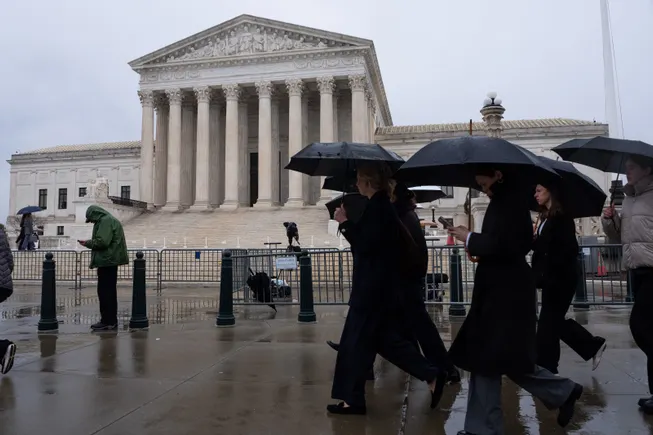
The U.S. Supreme Court questioned Wednesday whether workers involved in the transport of interstate goods are exempt via federal law from contractual agreements that compel arbitration, even if the workers themselves never cross state lines or work with vehicles that do so.
Parties to the case, Flowers Foods v. Brock, include baked goods producer Flowers Foods and the respondent, who distributes Flowers Foods products within Colorado. As described in the company’s 2025 petition for a writ of certiorari, the respondent picks up the products from a Colorado warehouse, where they are unloaded by Flowers, and delivers them to a territory that falls entirely within Colorado state lines.
Traci Lovitt, counsel for Flowers Foods, argued that such “last mile” workers are not covered by the Federal Arbitration Act’s exemptions because their work in transporting goods comes after those goods have already crossed state lines.
That position met skepticism from the court’s liberal wing. Justice Ketanji Brown Jackson, for example, questioned why any workers involved in the interstate journey of goods would not be included in the FAA’s exemption, so long as they are participating in the journey of those goods from their origin point in one state to their destination in another.
Lovitt replied that the exemption is confined to the loading and unloading of goods on the interstate journey itself rather than any travel that occurs before or after this journey, citing the court’s 2022 decision in favor of a Southwest Airlines worker who was deemed exempt because her work involved loading and unloading of cargo on and off planes traveling across state lines.
Justice Neil Gorsuch, who had pointed questions for both sides in the case, asked Lovitt why a “bright-line rule” adopted by the court would need to address whether a worker loads or unloads. He posited that the court could instead narrowly decide that the FAA exemption does not apply to workers who do not transport goods across state lines nor interact with vehicles that do so. Lovitt appeared to agree that the court could rule in this manner.
The dispute in Flowers Foods is a rematch of sorts at the high court two years after the justices weighed in on a similar case, Bissonnette v. LePage Bakeries, involving a Flowers Foods subsidiary. Flowers even features the same two opposing attorneys from that case.
In Bissonette, a unanimous SCOTUS held that truck drivers delivering baked goods for Flowers Foods were arbitration-exempt under the FAA — which exempts “seamen, railroad employees, or any other class of workers engaged in foreign or interstate commerce” — even though they did not work in the transportation industry.
Jennifer Bennett, counsel for the respondent, told the justices that interstate commerce under the FAA has never been understood to end the moment that goods cross a state border, but that instead such journeys end when the goods reach their final destination. As such, those workers “are, by definition, engaged in that commerce, regardless of whether they personally cross state lines or interact with a vehicle that does.”
The 1st, 9th and 10th U.S. Circuit Courts of Appeal have taken up this view, holding that the handling of goods which move through an interstate supply chain is sufficient to qualify such workers as engaging in interstate commerce. A split has emerged on the subject, however, with the 5th and 11th Circuits coming to the opposite conclusion.
The justices questioned the idea that each worker in a supply chain is necessarily involved in getting goods to their ultimate destination, in part because it is not always clear what that destination is.
Chief Justice John Roberts, for instance, noted that it could be argued that the destination for Flowers Foods’ bread is the consumer. Gorsuch said that a bread maker may consider the destination to be the distributor’s warehouse rather than a consumer or retail store because the distributor purchases the right to distribute the bread. Once the bread is offloaded to the distributor, the bread maker has “got its money,” Gorsuch said.
Bennett said she agreed with Gorsuch’s view and that the court could nonetheless decide the case on the more narrow question while saving the “destination” analysis for future disputes involving the exemption status of specific workers.
“The only thing this court has to say to answer the question presented is there is no absolute requirement that you physically cross a state line or interact with a vehicle that does, whatever it might mean to interact with a vehicle,” Bennett said.
In her rebuttal, Lovitt countered that the respondent’s position would add “a whole separate layer of litigation” about the intent of parties in a given transaction rather than provide needed clarity. The “whole point” of the FAA, she added, “is to avoid litigation, to have speed and efficiency in resolving conflicts.”