
The push for higher minimum wages continues to be primarily driven by state and local governments with the $7.25 per hour federal minimum wage stagnant since 2009. That figure has stood for nearly two decades despite advocates and even some employers voicing considerable support for an increase.
A total of 19 states increased their minimums in 2026, each of them landing between $10 an hour and $18 an hour. Nationwide, at least 30 states as well as Washington, D.C., have minimum wages that exceed the federal minimum, according to the Economic Policy Institute, a progressive think tank.
Below, HR Dive recaps this year’s new wage levels via a sortable table as well as a brief written description of each change.
| State | 2026 minimum wage | 2025 minimum wage |
|---|---|---|
| Arizona |
$15.15 |
$14.70 |
|
California |
$16.90 |
$16.50 |
|
Colorado |
$15.16 |
$14.81 |
|
Connecticut |
$16.94 |
$16.35 |
|
Hawaii |
$16.00 |
$14.00 |
|
Maine |
$15.10 |
$14.65 |
|
Michigan |
$13.73 |
$12.48 |
|
Minnesota |
$11.41 |
$11.13 |
|
Missouri |
$15.00 |
$13.75 |
|
Montana |
$10.85 |
$10.55 |
|
Nebraska |
$15.00 |
$13.50 |
|
New Jersey |
$15.92 |
$15.49 |
|
New York* |
$16.00 |
$15.50 |
|
Ohio |
$11.00 |
$10.70 |
|
Rhode Island |
$16.00 |
$15.00 |
|
South Dakota |
$11.85 |
$11.50 |
|
Vermont |
$14.42 |
$14.01 |
|
Virginia |
$12.77 |
$12.41 |
|
Washington |
$17.13 |
$16.66 |
*NOTE: New York state law sets a separate minimum-wage rate for New York City as well as Long Island and Westchester County, which is $17 an hour as of Jan. 1, 2026.
$10 to $12
Among the states with increases this year, the lowest 2026 minimum is Montana at $10.85 an hour, per an inflation adjustment mandated by state law. Ohio’s minimum is a few cents higher at $11 an hour, also due to an inflation adjustment.
From there, Minnesota and South Dakota implemented increases just shy of the $12 mark, at $11.41 and $11.85, respectively. Both increases came courtesy of inflation adjustments.
$12 to $15
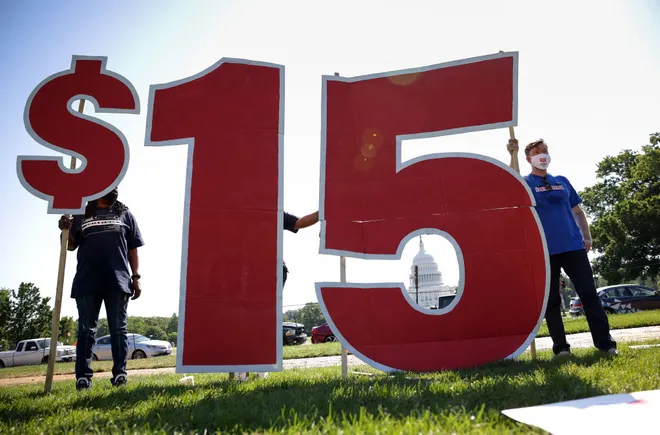
Of the 19 increases, five landed between $12 per hour and the oft-recognized $15 per hour mark that has long been a rallying point for the “Fight for 15” movement.
At the lower end, Virginia’s new hourly minimum comes in at $12.77, just below Michigan’s $13.73 per hour and Vermont’s $14.42 per hour.
From there, multiple states’ increases reached or exceeded the $15 an hour threshold, including Missouri, where voters approved a ballot initiative to increase the minimum during the 2024 election. Neighboring Nebraska also implemented a $15 hourly minimum beginning Jan. 1.
Arizona broke the $15 barrier this year at $15.15 per hour. Not to be outdone, Colorado’s minimum wage increased to $15.16 per hour — just one cent higher than that of the bordering Grand Canyon State.
Slightly shy of the $16 per hour mark sits New Jersey, where the minimum wage for 2026 is set at $15.92 thanks to an annual adjustment.
$16 or more
Multiple states crossed the $16 threshold this year, including Hawaii, where a 2022 law will push the minimum wage to $18 an hour beginning in 2028, and Rhode Island, which is set to adopt a $17 per hour minimum beginning in 2027.
California increased its minimum wage to $16.90, one of several workplace law overhauls the state enacted at the beginning of this year.
Most areas of New York state began enforcing a $16 an hour minimum wage on Jan. 1 pursuant to a schedule that state legislators passed in 2023. Separately, New York’s law provides for a $17 per hour minimum wage in the five boroughs of New York City as well as the nearby Westchester County and Long Island. Beginning in 2027, the state must adjust its minimum rates annually for inflation.
Washington state, meanwhile, takes the cake with the highest statewide minimum wage at $17.13 an hour; in 2026, Washington became the first state to adopt a statewide hourly minimum wage greater than $17. The state is also host to one of the highest minimum wage rates of any U.S. locality in 2026 thanks to Tukwila County’s $21.65 per hour mark.