
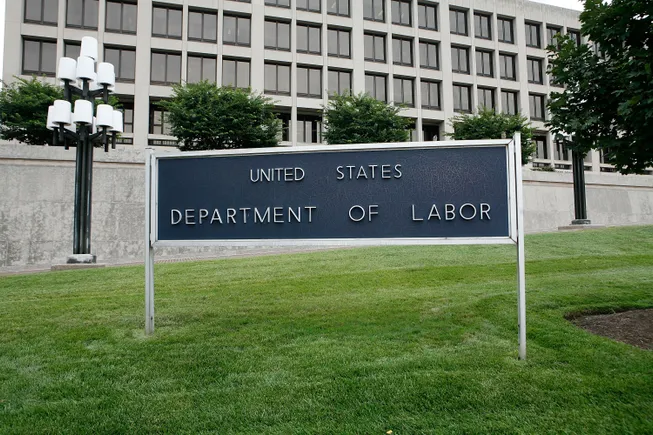
The U.S. Department of Labor issued a batch of four opinion letters on Jan. 5 cautioning employers on the role of certain performance-based bonuses and pre-shift “roll call” time in overtime calculations as well as overtime pay exemption for certain “learned professional” and commission-earning employees.
In one of the letters, the agency’s Wage and Hour Division said a set of bonus payments that rewarded waste management industry drivers for meeting safety, job duties and performance goals used “detailed criteria and one or more formulas” to determine worker eligibility.
Because the bonus requirements constituted a “predetermined plan to incentivize certain work performance,” the payments must be included in an employee’s regular rate of pay, which is used to determine overtime pay, according to DOL.
Generally, employers may exclude discretionary bonuses from an employee’s regular rate provided they have “sole discretion” over the amount and payment of the bonuses and so long as payment is not made according to any prior contract, agreement or promise that would cause an employee to expect such payment regularly.
But the employer in question set forth criteria within its bonus plan that quantified the amount of the bonus to be earned by an eligible employee, effectively abandoning its discretion to decide whether to pay the bonus and determine the amount to be paid, DOL said.
In an analysis of the letter, Littler Mendelson attorneys Nicole LeFave and Brian Rho wrote that the letter “reinforces a longstanding principle: if a bonus is promised in advance and triggered by conditions set by the employer, it must be included in the regular rate for overtime purposes.” The attorney said employers should review their bonus programs to ensure compliance.
A separate letter weighed the inclusion of 15-minute pre-shift roll call periods as compensable hours that must count toward overtime pay calculations. The agency said the 15-minute periods were part of a collective bargaining proposal between a group of emergency dispatch workers and their employer. The proposal stipulated that the roll calls would be considered hours worked but excludable from overtime calculations.
DOL said the roll calls could not be excluded because they constituted hours worked. The agency identified two exemptions under the Fair Labor Standards Act that would allow exclusion but noted that it lacked sufficient information about the collective bargaining agreement to affirm whether either exemption would be applicable.
DOL addresses niche exemption issues
The agency’s two other letters addressed whether employees qualified for exemption from overtime eligibility. In one, a healthcare organization initially classified a licensed clinical social worker as exempt but later informed the employee that they would be reclassified due to the loss of supervisory duties.
The employee maintained that they nonetheless should be classified as exempt under the FLSA’s “learned professional” exemption. This applies to employees who are paid on a salary or fee basis and whose primary duty is the performance of work requiring advanced knowledge in a field of science or learning that must be customarily acquired by a prolonged course of specialized intellectual instruction.
DOL wrote that the loss of supervisory duties on its own would not preclude exemption but that the employee’s conversion from being paid on a salary basis to being paid on an hourly basis may defeat exemption. “Moreover, even if you do meet the tests for the learned professional exemption, your employer may nonetheless choose to classify you as non-exempt,” the agency said.
Another scenario presented to DOL concerned the FLSA’s exemption for retail and service establishment employees who are paid at least partly on a commission basis.
Specifically, the letter asked how employers must apply the exemption in states with a higher minimum wage than the federal minimum, and which must be used to determine whether an employer has satisfied the exemption’s minimum pay standard. The letter also asked whether tips could be deemed compensation for purposes of the exemption’s requirement that more than half of an employee’s total pay in a representative period consists of commissions.
In its reply, DOL said that the text of the exemption explicitly incorporates the federal minimum wage. As for the second part of the inquiry, the agency wrote that tips are not considered commissions but that, in some cases, a portion of an employee’s tips could be counted as compensation for determining whether an employee is primarily paid by commission.