
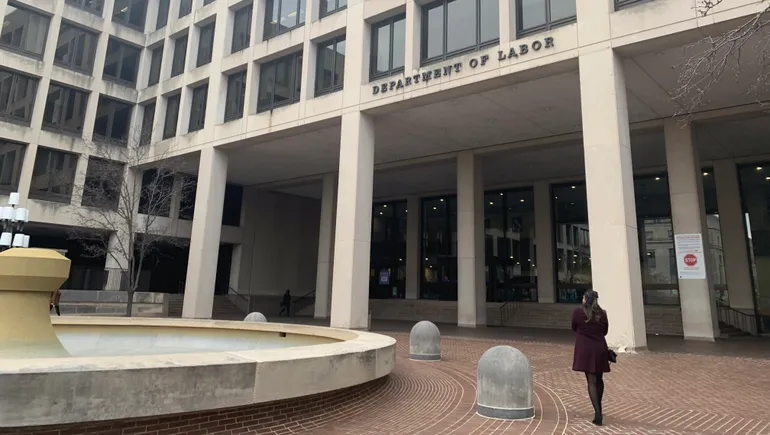
ORLANDO, Fla. — It’s rare for a high-ranking federal official to hand out their cell phone number in a public setting. And yet, that’s exactly what Assistant U.S. Labor Secretary Henry Mack did before a crowd of SHRM26 attendees on June 18.
Mack, a former university professor and current head of the Department of Labor’s Employment and Training Administration, said he wanted to speak with employers about federal job training funds that could help them and their employees better prepare for a changing labor market.
For example, several federal training and education grants provide funding that Mack said totals between $200 million and $300 million, though he acknowledged that those grants are often accessed by employers via partnerships with state and local workforce boards, community colleges and universities. Mack encouraged HR departments to engage with these stakeholders even if, in his words, they can sometimes be “a pain to work with.”
“There is no reason that bureaucracy should kill innovation and mobility,” Mack said. He also recommended that individual SHRM chapters adopt a local workforce board to help make those entities more responsive to employers’ talent needs. “I need you all to help drive the kind of change we’re advocating for.”
And should attendees need help interacting with a workforce board or looking for the right funding opportunities, Mack said they should give him a call. “I’m as serious as a heart attack,” he added after drawing a few laughs.
The U.S. labor market faces a broader, systemic issue in that many employees have higher levels of formal education than are necessary for the jobs they occupy, which Mack said points to a disconnect between the nation’s postsecondary education system and its ability to map skills to available jobs.
To solve that issue, education systems and institutions will need to move to competency-based and skill-informed learning, according to Mack. But he added that employers also must embrace hiring models that place less emphasis on formal degrees in favor of skills and capabilities.
On the latter front, DOL announced last year an interagency agreement with the Department of Education to create a national skills credentialing framework using Learning and Employment Records, which the agencies described as “machine-readible, industry-recognized competency statements” that captured workers verified skills.
LERs could prove to be more effective and comprehensive signals of workers’ skills than traditional transcripts or self assertions on LinkedIn profiles, Mack said. But employers need to buy into the idea; “Otherwise, it’s just going to be sort of a one-way street.”
DOL has advanced a number of training initiatives during the second Trump administration. Last year, it announced $30 million in funding for training in critical workforce shortages such as skilled trades and artificial intelligence. In April, it launched a website to provide organizations information on building AI literacy as well as AI-focused apprenticeships.
AI and the future of work dominated the conversation at SHRM26. Mack said he didn’t feel that the federal government has enough data to know precisely how disruptive the technology could be to specific employees or occupations but that DOL is nonetheless focused on giving employers resources to navigate any challenges.
“I am not yet convinced of the level of disruption [or] how radically AI is transforming certain occupations within different career clusters,” he continued. “However, we are doing everything possible to help local stakeholders to prepare for that in their local contexts.”
Mack also spoke about the importance of “human skills” — such as communication and writing — in a time of growing automation and technological change.
“We don’t want to lose the capacity and the ability to work with colleagues with empathy, sympathy and humility,” he said.