
ORLANDO — Last year was defined not just by diversity, equity and inclusion rollbacks, but by President Donald Trump coming down hard on DEI, with federal agencies enforcing the White House’s agenda accordingly.
Legal challenges to Trump’s anti-DEI orders haven’t seen significant success, but earlier this month, 20 attorneys general sued the administration over a contractor-related DEI order.
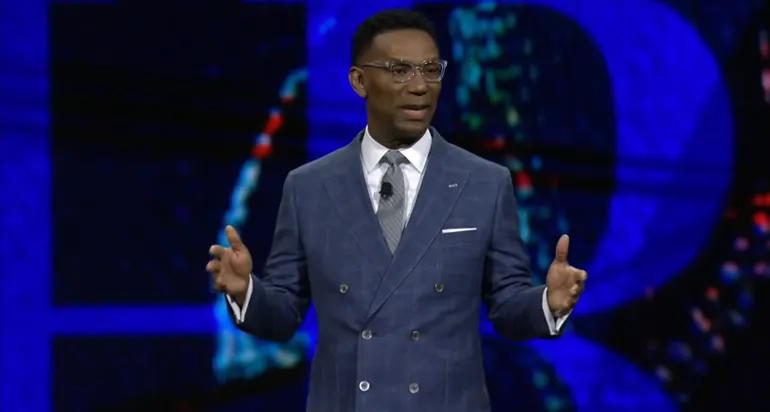
Acknowledging that the goalpost for HR professionals in the U.S. changes day by day, SHRM’s CEO and president, Johnny Taylor Jr., predicted that the future of corporate inclusion is going to be a “bumpy” ride over the next two years, particularly at the intersection of culture and law.
He pointed to the U.S. Equal Employment Opportunity Commission and how it is approaching Title VII of the Civil Rights Act. “For the first time, I’ve heard the EEOC consistently referred to as a law enforcement agency. We know that’s what they do — Title VII — but it’s not the way you think of them,” Taylor told HR Dive on June 17 at SHRM’s annual conference.
Acting Chair Andrea Lucas has, in Taylor’s opinion, “been very clear that her job is to find illegal discrimination.” Taylor said that while EEOC is still filing cases that seem more standard, such as its lawsuit against StoneMor Cemetery Management Company alleging race discrimination, he also has noticed some shifts.
It filed a lawsuit against a Coca-Cola bottler — which the company is fighting — claiming reverse discrimination against men, for example.
“It’s going to sound odd for me to say this, but I think over the next three years, what they’re going to have to do is reorient us as a profession — from focusing on groups that were just historically underrepresented and historically discriminated to broadly say any form of discrimination will not be tolerated,” Taylor said.
Letting go of the past, transitioning to the future
Taylor recalled his time as an HR practitioner and a labor lawyer, where clients would weigh someone’s race or gender before terminating them. “‘Are they a member of a protected class?’ Well, now, everyone’s protected,” Taylor said. “We had a heightened standard when it was a Black female or a Hispanic male; now it’s a White male. He’s in a protected class category, too.”
Attorneys told HR Dive at the top of this year that “reverse bias” may be the hot DEI topic of 2026. As for 2027 and 2028, Taylor predicted that employee resource groups and business development initiatives may be more of a focus. He also said charging parties may aim to take these cases to the Supreme Court before the administration changes in an effort to codify these DEI attitudes as the law of the land.
Other workplace experts told HR Dive earlier this year that without culture-based DEI commitments, some employers are not only less likely to find the right talent, but may even be inviting discriminatory, unlawful harassment at work.
SHRM’s desire to be early, always
The HR organization is not abandoning diversity and inclusion, Taylor said. Just last week, it unveiled the revamped SHRM Center for Inclusion and Diversity. Instead, the trade organization is encouraging a reframe, according to its CEO and president.
“SHRM’s job is to act as a meteorologist. When the U.S. Supreme Court outlawed affirmative action in higher education in 2023, we knew it was coming to the workplace. This was before there was President Trump. People are forgetting that,” Taylor said. He acknowledged that in 2023, “no one thought [Trump] was going to be president again,” but through time spent on Capitol Hill, SHRM leadership predicted there would be a change in how people would approach DEI.
Taylor noted the backlash to SHRM dropping the “E” from its inclusion acronym in 2024 distinctly. “I’ll remember it forever: July 9, 2024. People were livid. All we were saying was, much like AI, it’s coming, embrace this, or you’re going to be on the other side of this,” Taylor said. “And it’s going to be the wrong side of it.”
In light of the sociocultural and legal shift around DEI, he added, “That’s what we told you, but you thought we were making a judgment on equity.”
“The text of Title VII does not mention equity,” he continued, “it says equal. So, your job is to protect your company and to not let your values [or] your belief systems control it. Now, if we want to change the law, let’s change the law. Until such time the law has changed, you’ve got to comply with it.”
And as for SHRM’s new Center for Inclusion and Diversity, “that made no one happy,” Taylor said. Left-leaning people are upset at the exclusion of “equity;” right-leaning people are upset at the inclusion of “diversity,” he explained. But for Taylor, that is what leadership looks like.
“Diversity matters, we know it. The research tells us that. Inclusion for all matters, too. You get it right now, then you’re cooking with grease. It was a bumpy ride for us during that period, because people were pissed off,” he said. “But here we are now… Sometimes, we say, ‘We were right. We told you in 2024 we’d be here today, and we were right.’”