
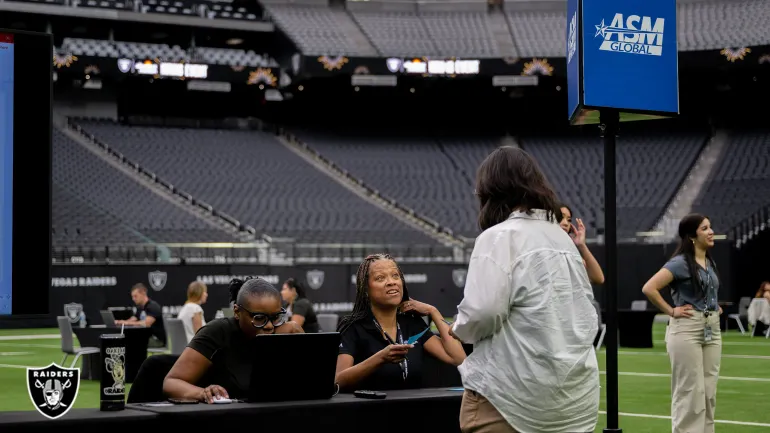
If ever a pre-season event has American sports fans on pins and needles, it’s the National Football League’s draft. Fans watch friends and family huddle around prospective players, who anxiously await a call welcoming them into their next chapter.
In some ways, it’s a lot like waiting for any recruiter’s call back saying, “You’ve got the job.” And this month, the NFL is calling on employers to evaluate candidates based on their skills, preparation and potential — not their criminal records.
The odds that formerly incarcerated talent are up against
At any given time, 6.9 million individuals in the U.S. are either in jail or prison, on probation or on parole, according to the U.S. Department of Health and Human Services. Of that number, some 600,000 people re-enter society from state and federal prisons each year.
Most prisoners are rearrested within 9 years of release
Rates of recidivism over time, according to a 2018 Bureau of Justice Statistics report. BJS observed recently released prisoners from 2005 to 2014.
While 68% of all released prisoners are re-arrested within three years, among those who are re-arrested by the nine-year mark, the number is much higher, at 82%. Still, the odds of reincarceration persist over time, according to the 2018 study. But data also shows that stable post-release employment can reduce recidivism. Securing a job — surviving the draft, if you will — can be the first step to successfully rebuilding one’s life post release.
At the same time, government frameworks that support formerly incarcerated people seem to have been deprioritized by the Trump administration.
Analysts such as those at the Brennan Center for Justice have pointed, for example, to the 2025 cancellation of U.S. Department of Justice grants related to the Second Chance Act — a piece of legislation that stemmed from a 2004 proposal by former President George W. Bush.
That means much of the responsibility for fair chance hiring may fall on the private sector — particularly hiring managers and recruiters who have the ability to hire in that way.
Why a second chance is mutually beneficial
It may come as a surprise to some that many formerly incarcerated individuals bring a competitive edge to the workplace. “Thankfully, not everyone has gone through the experience of being incarcerated, so they don’t necessarily know,” according to Genevieve Rimer, VP of capacity building and technical assistance at the Center for Employment Opportunities, an organization that partnered with the NFL for its fair chance hiring campaign and previously received an apprenticeship grant from the league.
Along with her professional advocacy for others, Rimer said she sees her own background as a strength. “Being formerly incarcerated is one of my most prized identities, because I am able to bring all of me to the workplace,” she told HR Dive, adding that the experience gave her both hard and soft skills.
Genevieve Rimer, VP of capacity building and technical assistance at CEO
Center for Employment Opportunities
“I learned how to be resilient. I learned how to be tough. I learned how to read the room. I learned how to work well with people. I had to show up and to do the job, when the job was really hard — when things didn’t look so optimistic for myself,” she said.
Rimer emphasized that she was far from an anomaly. “We, as formerly incarcerated people, are the whole package,” she said. “And if employers are intentionally overlooking us, they’re missing out.”
Some employers are leaning in. Giant Food, for example, has a second-chance program connecting inmates with jobs. Nonprofit organization Jails to Jobs, which provides everything from job search training to free interview clothes and low-cost tattoo removal, maintains a fair-chance employer database; notable directory members include the HR world’s own Indeed, along with Georgia Pacific and Johns Hopkins Medicine.
Fair chance hiring can be mutually beneficial, providing willing employers with a whole new pool to help fulfill their workforce needs, stakeholders have said. Likewise, it can help people secure much-needed roles — jobs many approach with gratitude, according to Rimer.
Rimer said it takes courage for a formerly incarcerated person to knock on a potential employer’s door and put themselves out there in the job process. “I wish employers knew what it took for us to do that,” she said. “Because we have all this internal stigma and shame that we’re constantly grappling with.”
“It’s a hard thing for anyone to do — to apply and to go through the interview process,” Rimer continued, highlighting the added layers of difficulty for recently released people. The more recent the experience of incarceration, she said, the harder it is. “Because you’re having to identify a new identity — a new narrative.”
Setting up formerly incarcerated talent for success
The NFL’s pitch to recruiters and hiring managers is perhaps a simple yet sizable ask: Look not only at an individual’s background, “but look at the person in the present day,” said NFL Senior Coordinator of Social Responsibility Trinity Monteiro. “Look at the work ethic, the preparation and the potential that they’re showing.”
“When we look at the data, it proves that formerly incarcerated individuals show up with a certain work ethic and grit,” she said; “HR professionals are not only pleased but thrilled with the performance that they’re seeing from these individuals.”
Rimer’s experience echoes those findings: “Once we’re given a fair opportunity in employment, not only do we become a valuable member of the workforce, but employment is so important to us [that] we move up,” she said.
But ultimately, people who have been in prison or jail aren’t so dissimilar from people who haven’t had such an experience, she said. “We go to the doctor’s office and we sit next to each other. We have dreams and aspirations and [goals]. We have families. We have things that we care about. We have values and morals. We are more alike than we are different,” Rimer said. “But I think our differences actually make us special and unique — instead of something that is usually seen as negative.”