
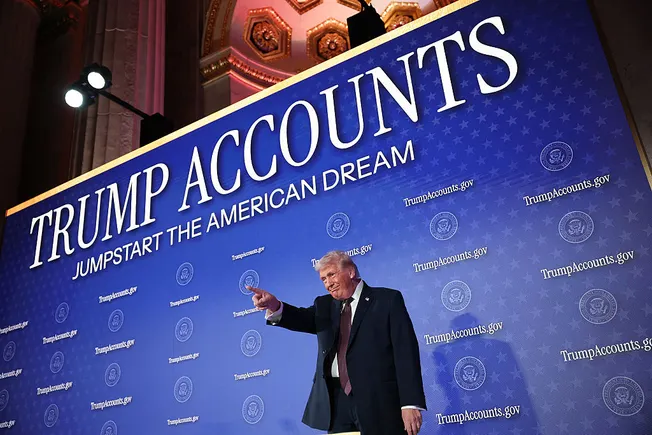
Employers may be slow to offer contributions to a new tax-advantaged retirement account created by Congress as part of the 2025 One Big Beautiful Bill Act, one management-side attorney told HR Dive.
530A accounts, also known as Trump accounts, are a form of individual retirement account, or IRA, that can be established for children under age 18 before the end of the calendar year in which an election is made. According to the IRS, Trump accounts are tax-deferred and must be invested in certain mutual funds or exchange-traded funds.
Trump accounts established for U.S. citizen children born on or after Jan. 1, 2025, and before Jan. 1, 2029, also will receive a contribution of $1,000 from the federal government as part of a pilot program.
Parents and those seeking to contribute to the accounts may not do so before July 4, 2026. Employers also will be able to contribute up to $2,500 per year to an account held by an employee or the employee’s dependent, with those contributions not counted toward the employee’s taxable income.
Despite these benefits, employers are still awaiting further IRS guidance regarding how they can establish programs to contribute to the accounts via what the law calls Section 128 employer contributions, said Lisa Tavares, partner at Venable LLP. In a December notice, the IRS said Section 128 contributions would be subject to requirements similar to those for dependent care assistance programs. In the meantime, employers should expect financial institutions to begin rolling out details for how they will provide the accounts, Tavares said.
But absent clearer guidance, Tavares said she had not seen much interest in the accounts from employers, who are more likely to continue to contribute to employees’ 401(k) plans or other existing plans. That the government has not yet published guidance with just months to go before the July 4 deadline also complicates desire for uptake.
“It’s going to be a game-time type decision, which is not really the best way to run employee benefit plans,” Tavares said. Should employers adopt the accounts, most will likely do so through their retirement plan providers for easier administration, she continued.
Trump accounts are not intended to be covered by the Employee Retirement Income Security Act. For that reason, Tavares said she would caution employers against providing investment advice related to the accounts. General information regarding how the employer’s contribution plan works, including the vendor or provider through which the employer will operate the plan, would be okay to provide though.
“It’s a non-ERISA plan, so similar to other voluntary programs, the employer should take reasonable steps to ensure they’re using and making available a vendor who is reputable,” Tavares said.
Employers also should be aware that, because Trump accounts appear to be subject to the same requirements as dependent care accounts, they may be affected by nondiscrimination rules that prohibit plans which disproportionately benefit highly-compensated employees.
If this is the case, Tavares said, employers who run into this kind of scenario may need to increase contributions on behalf of non-highly-compensated employees or reduce contributions for highly-compensated employees.
“That’s just an administrative challenge that may deter some employers from wanting to take on another plan where they have to monitor compliance,” she added.
Business groups are aiming to receive more clarity from the IRS on such topics. For example, the U.S. Chamber of Commerce submitted public comments to the agency asking it to address questions on the applicability of ERISA to Trump accounts as well as nondiscrimination rules, among others.
But in the meantime, Tavares said employers should prepare if they want to move fast to support employees’ Trump accounts.
“My biggest takeaway for HR leaders is that they need to start lining their ducks up in a row if they want to do this for 2026,” Tavares said.