
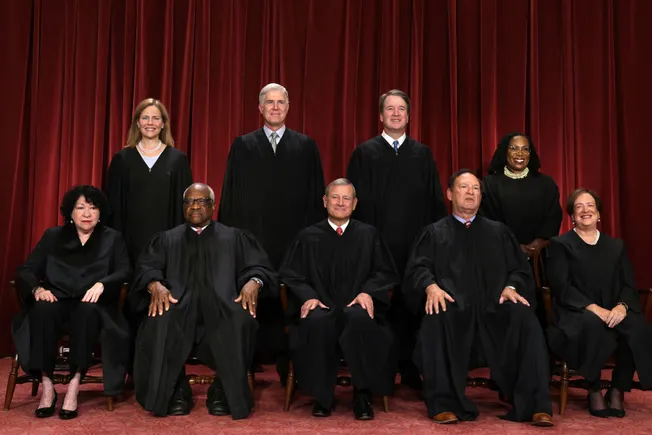
U.S. Supreme Court justices seemed likely Monday to ditch the court’s long-standing precedent insulating leaders of independent regulatory commissions from at-will removal by the president in what would be a victory for President Donald Trump.
Several members of the court’s conservative majority spoke unfavorably of the 1935 decision in Humphrey’s Executor v. U.S. that upheld the constitutionality of removal protections for members of agencies like the Federal Trade Commission and National Labor Relations Board.
For instance, Chief Justice John Roberts — echoing an earlier statement by Solicitor General John Sauer — said the court’s subsequent jurisprudence had rendered Humphrey’s Executor a “dried husk of whatever people used to think it was.” Roberts added that the New Deal-era FTC described in the case is “vanishingly insignificant” considering how the agency has transformed since that time.
Few on the court were as critical of Humphrey’s Executor as Justice Neil Gorsuch. In questioning Amit Agarwal, counsel for fired FTC member Rebecca Slaughter, Gorsuch asked why the court should not decide that Humphrey’s Executor was “poorly reasoned” and had created an unlawful fourth branch of the U.S. government.
Moments earlier in the session, Gorsuch appeared to take his argument a step further. In a remark to Sauer, Gorsuch said the court might look to revive its “intelligible principle” standard and determine whether Congress had improperly delegated its authority to agencies like FTC, which he and others on the court said possess substantial executive power.
The intelligible principle standard, articulated prior to Humphrey’s Executor, held that Congress must provide an intelligible principle by which entities to whom it delegates authority must follow when exercising that authority. SCOTUS has distanced itself from the standard over the years, per the Congressional Research Service, but Gorsuch asked Sauer whether it was time for the court to revisit it given that the court has since generally permitted congressional delegation to FTC and other agencies.
“The court has allowed that for a very long time,” Gorsuch said. “I take the point that this has allowed a bargain where a lot of legislative power has moved into these agencies, but, if they’re now going to be controlled by the President, it seems to me all the more imperative to do something about it.”
However, multiple justices suggested that the structure of FTC and other agencies could avoid being entirely struck down if the court decided to sever the at-will dismissal protections created by Congress from each agency’s respective statute.
Justice Brett Kavanaugh confirmed this point during a line of questioning with Sauer, who argued that the court had held against similar removal protections in past cases without threatening the existence of affected agencies.
Sauer also appeared to confirm to Justice Elena Kagan that a ruling for Trump would not mean the end of the NLRB, the Merit Systems Protect Board and similar multimember agencies.
The court took up Trump v. Slaughter in lieu of other cases filed by Democratic officials whom Trump fired at-will, including Gwynne Wilcox, a former NLRB member. Jocelyn Samuels, a former commissioner of the Equal Employment Opportunity Commission, also sued the White House over her dismissal. A federal judge stayed Samuels’ case in October.